Oil Painting “Liberation Road”

My most accomplished painting to date is a portrait of an old woman, Grandma (2003), while its companion painting, Liberation Road (2010), is my most personal one.
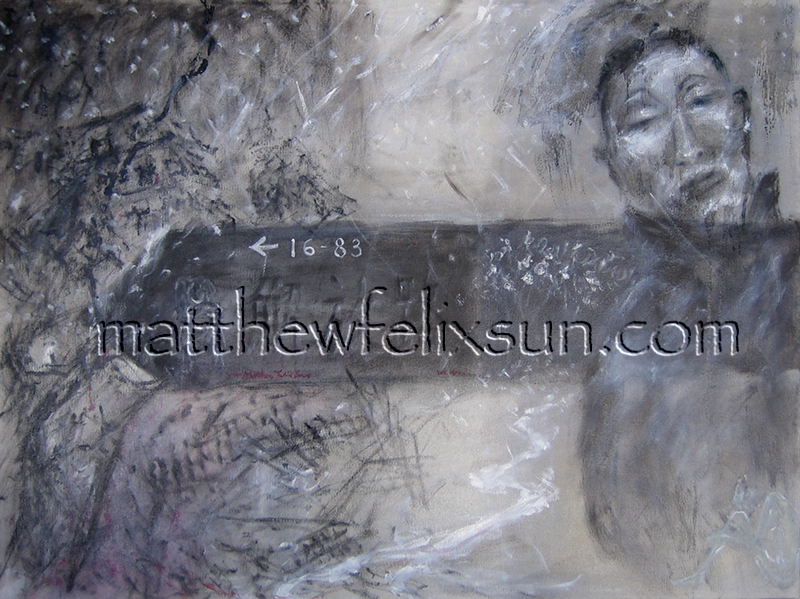
Liberation Road / 解放路 / Befreiungstraße, Oil on Canvas, 18" x 24", Completed in 2010
Liberation Road
oil on canvas, 18″x24″, 2010
sold
17 Paintings Completed in 2010 (part 2 of 2)

This painting was based on a photo of my paternal great great grandmother, or maybe great grandmother, I do not really know for sure.  She was a very elegant woman with a knowing look and her photo had often haunted me and caused me to wonder what had happened to her, to her family, to her descendants in the ensuring years – all those endless upheavals, wars, famine – human suffering of all kinds, from the end of the imperial time, the republican era and culminated in the so-called revolution in the mid-twentieth century. Furthermore, this painting also touched on the traumatic experiences my parents and my sibling and myself suffered in the iron grip of the Chinese Communist Party, or any totalitarian regime, even to this very day.

The left side of the painting showed ruined houses and railroads, balancing the right side of the portrait of my dignified grandmother.  The horizontal road sign bisecting the painting read “Liberation Road”, yet at the end of the arrow, we saw a sorrow-stricken person, helplessly rested his/her head on the knees, anything but liberated.  There was a similar figure, at the lower right of the painting, echoing this figure, in the same posture, though in profile.

I made this painting to pay tribute to my elegant ancestors who had striven to achieve personal enlightenment and successes and later suffered precisely for their achievements in the hands of the anti-intellectual and self-righteous puritanical Communist Party.  By surrounding my great grandmother with ruins and other suffering people, I tried to demonstrate the scope of the destruction in the wake of the Communist Party.

I also made a short video (1:56) to present this rather haunting painting.

In order to show both the complete picture and its details as the “camera” panning across the canvas, I incorporated two video clips into one single final video and they can be played simultaneously.  I deliberately kept my left clip static, so as to show the complete painting, while the right clip demonstrate the details, exactly as the video above.
Oil Painting “The Song of Orpheus”

I have always been drawn to the complex, intensely humane and deeply flawed characters in Greek mythology, and have made several paintings of based on several such figures, e.g. Minotaur, Daphne and Apollo, Helen of Troy, and Oedipus, etc.

One of my such efforts was an oil painting on the theme of Orpheus, one of the most famous musicians in human history, conceived while I was reading Rainer Maria Rilke’s Die Sonette an Orpheus.

That subject was a dangerous ground to tread into, because there were so many wonderful artworks had been created after this Orpheus myth, from paintings to operas; yet the lure of this myth and the reinterpretation by Rilke was so strong and irresistible, I pressed on.

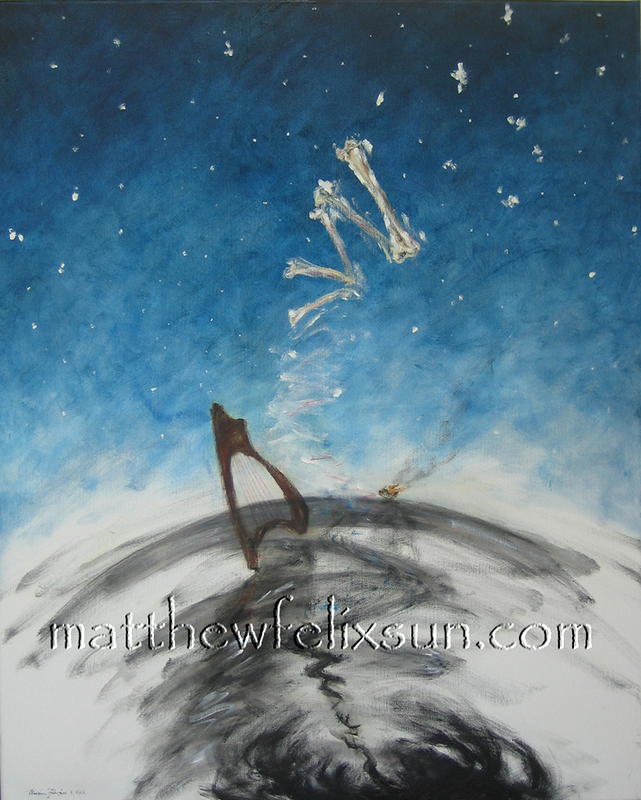
My Orpheus was a collage of many variations of the much-told myth.  My painting started with his descend into Hades to seek his beloved Eurydice, traveling on the River Styx.  His lyre, which had persuaded Hades and Persephone to let Eurydice return to the earth, dominated the canvas.  The lyre also took a shape of a strange animal, and was also a linkage to Apollo.  After he had lost Eurydice for the second time, the grief driven Orpheus refused to entertain Dionysus’ followers who in their rages ripped him to pieces.  His skull became an oracle and his flesh and bones were tossed into sky, scattered about and filled the universe with his music.

Thus the marriage of Apollonian and Dionysian spirits ushered in a new era.

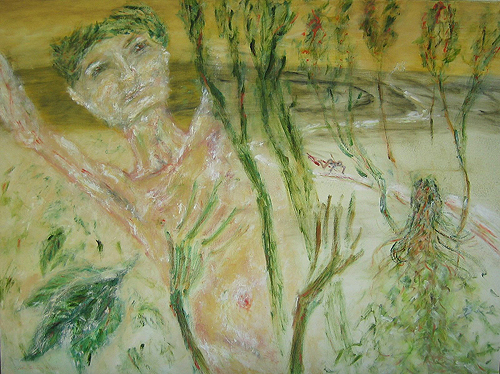
The Song of Orpheus / 奧菲厄斯的歌 / Das Lied des Orpheus, Oil on Canvas, 30" x 24", Completed in 2010
The Song of Orpheus
oil on canvas, 30″x24″, 2010

17 Paintings Completed in 2010 (part 2 of 2)

I saw Orpheus as the means to bring joy and meaning to the world, through his irrepressible quest for love and his suffering, and ultimately his death. I saw his lyre singing and I saw his bones being scattered into the highest sphere, just like his notes would have crowned the heaven. Holy ointment burned in his skull, which had transformed into an oracle, rising up to dance with his ever higher notes. That’s The Song of Orpheus.

Portrait Painting “Grandma”

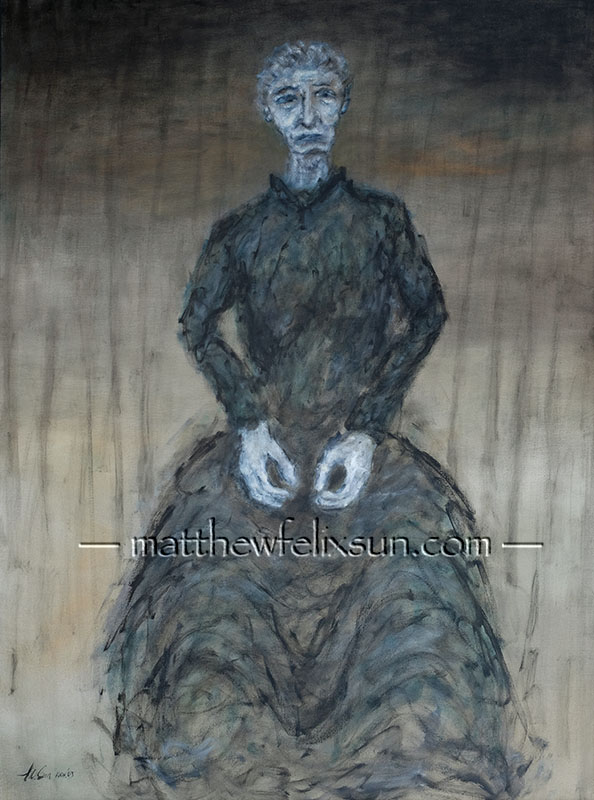
If I have to summarize my career as an artist, I would say that the biggest achievement I’ve attained was the creation of my portrait painting “Grandma”.

Grandma / 祖母 / Oma, Oil on Canvas, 40" x 30", Completed in 2003
Grandma
oil on canvas, 40″x30″, 2003

11 Paintings Completed in 2003 (part 2 of 2)

This painting, created during the time when George W. Bush was drumming up to invade Iraq, despite the series opposition from the people within and without the US.

At the time, I was reading Günter Grass’s fantastic novel The Tin Drum (Die Blechtrommel), and was struck by a passage depicting the a protagonist’s old peasant grandma, whose presence in the novel, though not frequent, but impressive, due to the wonderful depiction of the author of her at various phases of her long life – many layers of her skirts, her peeling potatoes, the heated bricks
she used to stay warm, again, underneath her layers of skirts.

I have painted several portraits of old women. To me, they often can be categorized as sibyl, a word comes (via Latin) from the Greek word σίβυλλα sibylla, meaning prophetess. Old women are the personifications of mysterious wisdom and deep compassion, and the grandma in The Tin Drum was the personification of just that.

To generate a working-class and wise woman, I gave her a pair of large knotting hands and wrinkled face, and emphasized her stiff posture, against the equally thinly painted menacing sky, and somewhat comforting trees, whose monumentality again gave the grandma an air of a Greek goddess, all seeing, compassionate, and formidable.

This painting is part of my ongoing Apocalypse Series and was chosen by ArtSlant as a Showcase Winner.

Oil Painting “Arabesque”

The medium or media we choose to convey our deepest feelings and expressions, etc., however competent, can never fully convey the whole complicated concepts our brain formed mysteriously, thus the endless striving to meet the challenge, to do a better job still in the next given opportunity, thus the hunger to develop and grow as an artist, be it visual, musical compositional or a writing kind.

It also occurs often enough that one form of artistic creation, spurs on the re-interpretation with another media of either the whole story or a fleeting moment, not necessarily to prove a better job can be done; rather, to add another dimension to the engaging concept while hoping to complement the original.

I have been stimulated, on multiple occasions, by novels I read, sometimes the whole atmosphere of the book, such as Blindness by José Saramago, or sometimes, just a specific passage which may not even be pivotal in the whole scheme, such as my newly completed oil painting, Arabesque, inspired by a passage from The Known World by Edward P. Jones: “… looked over at the open chiffarobe [sic], whose door was broken and so would never close properly, looked at the black dress hanging there. It seemed to have its own life, so much life that it could have come down and walked over and placed itself over her body. Fastened itself.”

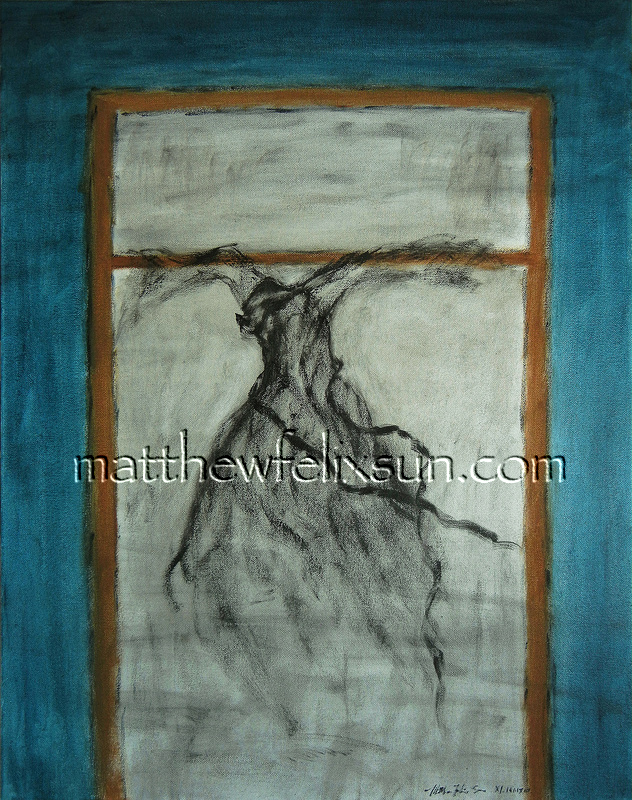
Arabesque / 阿拉伯風 / Arabeske, Oil on Canvas, 28" x 22", Completed in 2013
Arabesque
oil on canvas, 28″x22″, 2013

I actually was quite stirred by the passage and the image just flooded into my mind. Incidentally, this painting also fell into a painting scheme of mine – I have been working on a series of “White Dresses”, which I saw as both liberated and restricted, at once individual and impersonal, simultaneously beautiful and sinister. Now it started the companion series “Black Dress”.

9 Paintings and 3 Installations Completed in 2013 (part 1 of 2)